
Moving From Vancouver to Toronto: Costs, Timeline and What to Expect

Vancouver to Toronto is one of the longest household moves you can make inside a single country. Roughly 4,440 kilometres by road, across five provinces, three mountain ranges and three time zones. It is not a long local move. It is a logistics exercise, and the companies that treat it like one are the ones
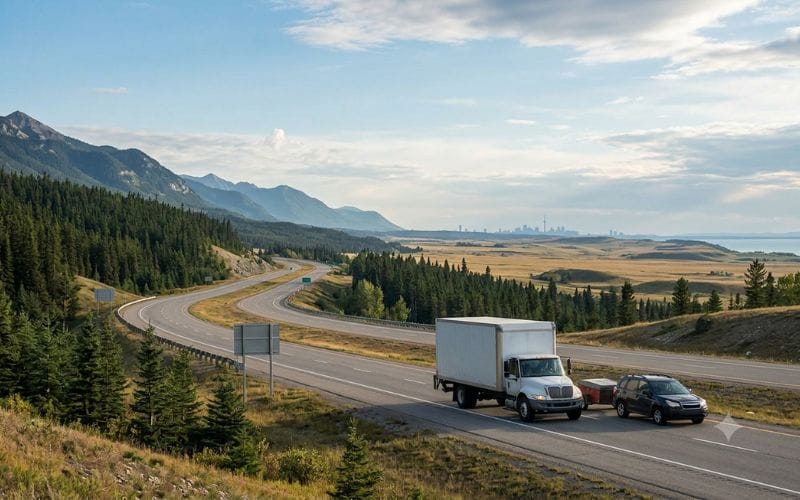
Vancouver to Toronto is one of the longest household moves you can make inside a single country. Roughly 4,440 kilometres by road, across five provinces, three mountain ranges and three time zones. It is not a long local move. It is a logistics exercise, and the companies that treat it like one are the ones that deliver on time.
Moving Co. moves households from Vancouver to Toronto with our own crews and our own trucks, start to finish, with no broker in the middle. Call 905-752-7787 or request a free quote and we’ll talk through dates and volume.
The route and the realistic timeline
Road distance is about 4,440 kilometres. In a loaded truck, with legally required driver rest, that is several days on the road rather than a long weekend. Plan for the load, the transit and the delivery as three separate things rather than one continuous event.
The route crosses the Coast Mountains and the Rockies, then the prairies, then the long northern Ontario stretch above Lake Superior. Each section has its own character. The mountain passes are the weather risk. The prairies are fast but monotonous. Northern Ontario between Thunder Bay and Sault Ste. Marie is remote, two lane in places, and the section most likely to close in bad conditions, because there is no parallel route to divert onto.
We give you a delivery window rather than a delivery minute, and we would rather give you an honest window we hit than a specific hour we miss. Anyone promising you an exact delivery time on a 4,400 kilometre move in February is telling you what you want to hear.
Winter across the mountains
This is the single biggest variable on this route and it deserves saying plainly.
Between roughly October and April, the mountain passes between the coast and Alberta can close on short notice for snow, avalanche control or collisions. British Columbia has legal winter tyre and chain requirements on designated highways during the winter months, and commercial vehicles are subject to their own rules. A closure is not a delay of an hour, it can be a delay of a day, and there is frequently no alternative route.
None of that makes a winter move a bad idea. Winter is quieter, easier to book, and generally cheaper than peak summer. It does mean you should build a buffer into your plans, avoid scheduling a flight, a key handover and a delivery on the same day, and treat any delivery date in that window as a target rather than a guarantee. We will tell you honestly what the risk looks like for your dates.
Why volume matters more here than anywhere
On a cross country move of this length, every item you bring is being transported 4,440 kilometres. That is the whole economics of it.
The honest calculation is simple: for a lot of ordinary furniture, the cost of moving it across the country is comparable to the cost of replacing it at the other end. Flat pack furniture, mattresses, basic bookcases, garden equipment and old appliances rarely justify the distance. Anything genuinely good, genuinely solid, or genuinely irreplaceable absolutely does.
So the most valuable hour you spend on this move is the one where you go room by room and decide honestly what is actually coming. We can clear the rest on the same visit through junk removal and furniture removal, so you’re not paying to ship things you’ll regret at the other end. People routinely cut a Vancouver to Toronto move by a third this way.
Vancouver access, and what slows a load down
Vancouver’s building stock and geography create their own constraints.
The downtown peninsula, Yaletown, Coal Harbour and the West End are dense high rise, which means elevator bookings, loading bay reservations and strata rules, much like downtown Toronto. Most towers require a certificate of insurance and an elevator booking with notice, and many restrict move times.
Outside the towers, the older housing is a different problem. Character houses across the East Side, Kitsilano and Mount Pleasant frequently have basement suites, laneway houses, or upper floors reached by narrow interior stairs. Lanes are common and are often the only realistic truck access, and they can be tight for a full size vehicle.
Tell us the building type, the floor, and whether there’s lane or street access when you book, because on a cross country move a slow load has knock on effects all the way to the delivery date.
Arriving in Toronto
If you’re landing in a Toronto condo, the building will almost certainly require an elevator booking and a certificate of insurance from the moving company before the crew gets past the concierge. Loading docks are booked in windows, and some buildings prohibit moves on Sundays and statutory holidays entirely.
We handle that side for you. Give us the destination building and unit and we deal with property management directly, so the reservation and the paperwork are in place before the truck arrives rather than being discovered on the day. It’s routine for us across CityPlace, Liberty Village, Yorkville and North York, and for houses across Toronto and the wider GTA.
A practical note on the time difference: Toronto is three hours ahead of Vancouver. If you’re coordinating a delivery from the coast, or handing over keys remotely, that gap causes more scheduling confusion than anything else on the move. Agree times in one time zone explicitly and write it down.
Changing provinces: BC to Ontario
A few things need doing, and health coverage is the one with real consequences.
- Health coverage. British Columbia and Ontario run separate provincial plans. Register with the Ontario plan as soon as you arrive and understand how the waiting period applies to you, since there can be a gap where you are covered by neither if you leave it late.
- Driver’s licence and vehicle registration. There are time limits for exchanging an out of province licence and registering a vehicle in Ontario. Bring your licence, proof of address and vehicle documents.
- Auto insurance. British Columbia has a public auto insurance system and Ontario does not. This is not an address change, it is a new policy, and you should sort it before you need to drive in Ontario.
- Getting the car across. Decide early whether you’re driving it, shipping it, or selling it. All three are reasonable. Driving 4,400 kilometres sounds romantic in June and considerably less so in January.
- Address changes. Canada Revenue Agency, banks, payroll, subscriptions, and mail forwarding through Canada Post.
Rules and time limits change, so confirm current requirements with ServiceOntario rather than relying on secondhand advice. Our interprovincial checklist sets out the order to do things in.
How we price it
We bill for time rather than inventing a flat rate with padding in it. The rate is $50 per hour per mover plus $49 per hour for the truck, so two movers and a truck is $149 an hour, one hour minimum, then 15 minute increments. Crew size, access at both ends and the volume you’re actually moving are what drive the total, which is why we ask detailed questions before quoting. The $149 rate applies to select non-peak dates, and peak-period pricing may vary.
No trip fees, fuel surcharges, stair fees or equipment fees appear afterwards. The pricing page has the full breakdown and the moving cost calculator will get you in the right range before you call.
The thing to be careful about with cross country quotes generally is not the rate, it’s the structure. A lot of long distance operators are brokers: they take your booking and sell the job to whichever carrier bids lowest. That is how people end up with an unfamiliar truck, a delivery window that slides by weeks, and nobody accountable when something goes missing. We do not broker. Our crews and our trucks do the whole job, which is the core of our long haul moving service.
Packing matters more on this route
Across town, a badly packed box survives because it is only in the truck for twenty minutes. Across the country it is in the truck for days, over mountain passes and prairie frost heave, with the load shifting the entire way.
Dishes, glassware, electronics, artwork, lamps and anything with a screen are worth packing properly rather than hopefully. Same for anything sentimental, because it is the one category you cannot simply replace at the other end. If you’d rather not do it yourself, that’s what packing and wrapping is for, and on a move this long it’s the add on we most often recommend people actually take.
Label by room in the destination, not the origin. It sounds obvious and almost nobody does it, and it saves an entire afternoon at the Toronto end.
Storage between the two ends
Dates almost never line up perfectly on a cross country move. A Vancouver lease ends on the 31st, a Toronto closing is on the 15th of the following month, and something has to give.
Rather than forcing a same day handover across three time zones, we can hold your shipment and deliver when you’re actually ready. Tell us about the gap when you book so it’s planned into the load rather than improvised later. Details on storage services.
Things that can’t ride in the truck
On a transit of this length the list matters more than usual, because there is no popping back for something.
Flammables and pressurised containers. Propane, gasoline, camping fuel, paint, solvents, aerosols and pool chemicals. Genuine fire risk in a sealed trailer, and no reputable carrier will load them. Use them up or take them to a hazardous waste depot before moving day.
Plants. Several days in a dark trailer with no water and large temperature swings will finish most houseplants. Rehome them, or carry the few you genuinely care about in the car.
Pets. They travel with you, never in the truck. If you’re flying, sort the pet booking before anything else, because airlines cap the number of animals per flight and those places go early, particularly in summer when temperature embargoes also apply.
The box that travels with you. Passports, birth certificates, medical and custody documents, medication, jewellery, laptops, chargers, keys and the paperwork for the new place. On a multi day transit you will need those long before the truck arrives.
What actually changes when you swap coasts
Worth knowing, because it affects what you bother bringing.
Toronto has a real winter. Vancouver’s is mild and wet; Toronto’s involves sustained cold, actual snow accumulation and ice. If you have been in Vancouver a long time, your coat is probably not adequate and your car may need winter tyres, which are far more common in Ontario than on the coast. Conversely, your rain gear will get less use than you expect.
Summer is the bigger surprise for most people. Toronto is hot and humid from roughly June to September in a way the coast simply is not. Air conditioning is not optional in most Toronto homes.
Space and price are complicated rather than simply better or worse. Both cities are expensive. Toronto generally offers more housing options at more price points, and a great deal more of the city is reachable by transit, but neither is a cheap place to live and you should not plan the move around expecting a windfall.
The three hour time difference will affect you more than you expect for the first fortnight, particularly for work calls. Toronto’s business day is effectively over by early afternoon Pacific time.
Timing your own arrival
On a move this long, you and your belongings travel separately, and people underestimate the gap.
Do not book a flight that lands the same morning your delivery is scheduled. If the truck is early you cannot receive it, and if the truck is late you are sitting in an empty apartment with luggage. Give yourself at least a day of overlap, and plan for the first night in the new place as though the truck has not arrived: an air mattress or a hotel, a change of clothes, chargers, and the coffee situation sorted.
If your delivery window is genuinely uncertain because of winter, it is worth budgeting for a couple of nights in a hotel rather than assuming the best case. It is a small cost against the stress of the alternative.
A sensible timeline
The distance means everything needs longer than it would locally, and the mistakes are expensive to unwind from 4,400 kilometres away.
Ten to twelve weeks out. Book the move, especially for a summer date. Decide what happens to the car. If you’re flying with pets, book that now, before flights and before anything else.
Six weeks out. Do the honest room by room cull, because on this route it’s worth real money. Book the clear-out for the same day as the load. Start the health coverage and licence paperwork.
Three weeks out. Confirm the Toronto building’s rules and start the elevator booking. Sort out the Vancouver strata’s move-out requirements, which often need more notice than people expect. Arrange somewhere to sleep in Toronto for the first night or two.
The last fortnight. Use up or dispose of everything that can’t travel. Pack the box that rides with you. Confirm your flight lands at least a day before the delivery window opens, not the same morning.
What we will tell you honestly
A few things we say out loud that the industry generally does not.
We will not promise an exact delivery hour on a 4,400 kilometre winter move. Anyone who does is either inexperienced or telling you what closes the sale.
If your load is genuinely small, a full household crew and truck is the wrong tool and we will say so. A studio or a one bedroom is usually better handled as a small move, and that costs you less.
If a piece of furniture is not worth 4,400 kilometres of transport, we will tell you that too, even though volume is what we bill for. It is a short term loss and an obvious long term gain, because people remember who was straight with them.
And if we cannot hit your dates, we will say so at the quote rather than taking the booking and managing the disappointment later. Availability is the one thing we genuinely cannot conjure.
Frequently Asked Questions
How long does a move from Vancouver to Toronto take?
The road distance is roughly 4,440 kilometres, which in a loaded truck with required driver rest is several days of transit rather than a single run. We give you a delivery window rather than an exact hour, because weather in the mountain passes and across northern Ontario is a genuine variable. Anyone promising you a precise delivery time in winter is guessing.
How much does it cost to move from Vancouver to Toronto?
We charge for time rather than a padded flat rate: $50 per hour per mover plus $49 per hour for the truck, so two movers and a truck is $149 an hour, one hour minimum then 15 minute increments. On a move this long, how much you actually bring is the biggest factor in the total, which is why we recommend cutting volume hard before you book. That $149 rate applies to select non-peak dates. Peak-period pricing may vary.
Is it worth moving furniture that far, or should I replace it?
Be honest item by item. Flat pack furniture, mattresses, basic shelving, garden equipment and old appliances rarely justify 4,400 kilometres of transport. Solid, good quality or irreplaceable pieces usually do. Cutting volume is the single most effective way to reduce the cost of this move, and people routinely cut a third.
Do you subcontract or broker cross country moves?
No. Our own crews and our own trucks handle the whole job. Brokering is widespread in long distance moving and it is why people end up with a truck they never booked and a delivery date that slips by weeks with nobody accountable. You deal with us from the first call to the last box.
What happens if the mountain passes close in winter?
It can add a day or more, and there is often no alternative route. Between roughly October and April the passes can close for snow, avalanche control or collisions. We build that into winter planning, give you a realistic window, and keep you updated rather than going quiet. Build a buffer day into your own plans and don’t stack a flight, a handover and a delivery on the same afternoon.
Should I drive my car or ship it?
Both work and it depends on the season and your timeline. Driving 4,400 kilometres is a genuine multi day trip and considerably harder in winter. Shipping costs more but frees you to fly. Selling in Vancouver and buying in Toronto is also perfectly sensible. Decide early, because it affects your travel booking.
What do I need to change moving from BC to Ontario?
Register for Ontario health coverage promptly and check how the waiting period applies, exchange your driver’s licence and register your vehicle within the required time limits, and arrange new auto insurance, since British Columbia has a public system and Ontario does not. Then the usual address changes. Confirm current requirements with ServiceOntario, as they change.
Can you store our things between the two dates?
Yes, and it’s common on this route. A coast lease rarely ends the same day a Toronto place becomes available. We can hold the shipment and deliver when you’re ready rather than forcing a same day handover across three time zones. Mention the gap when you book so we plan the load for it.
Do you handle the condo elevator booking at the Toronto end?
Yes. Most Toronto towers require an elevator reservation and a certificate of insurance from the moving company before a crew is allowed past the concierge, and docks are booked in windows. Give us the destination building and unit and we arrange it with property management ahead of the delivery date.
Tell us what you’re bringing and when you need to be out, and we’ll give you a straight answer on timing and cost. Request your free quote or call 905-752-7787.