
Best Moving Companies in Toronto (2026): Honest Comparison of Rates, Minimums and Hidden Fees

Short answer: the best moving company in Toronto for most people is the one with the lowest total cost, not the lowest hourly rate. In 2026 the going rate across the GTA sits between $125 and $165 per hour for two movers and a truck, but the hourly number decides less than half of your

Short answer: the best moving company in Toronto for most people is the one with the lowest total cost, not the lowest hourly rate. In 2026 the going rate across the GTA sits between $125 and $165 per hour for two movers and a truck, but the hourly number decides less than half of your final bill. Minimum charges, rounding rules, trip fees and fuel surcharges decide the rest. This guide compares the companies Toronto movers actually shortlist, shows the arithmetic most quotes hide, and explains where Moving Co. fits.
A note on who wrote this: this guide is published by Moving Co., a Toronto moving company. We rank ourselves highly in it, so read us with that in mind. Everything we say about other companies comes from their own public websites and listings, linked so you can check it. Everything we say about ourselves is verifiable too, starting with our Google rating.
The 2026 Toronto moving market in one paragraph
Toronto has somewhere north of four hundred registered moving operations, and the barrier to entry is a truck and a phone number. That is the whole problem. A search for the best movers in Toronto returns a hundred companies all using the same three adjectives, and roughly half of them are lead brokers who sell your phone number to whoever bids on it rather than crews who will show up at your door. The companies worth your time are the ones who publish a rate, own their trucks, employ their crews, and put their minimum charge in writing before you book.
Here is what the market actually charges in 2026. Two movers with a truck run $125 to $165 per hour. Three movers run $175 to $250. Most companies impose a two hour minimum on weekdays and a three hour minimum on Saturdays. A large number add a separate travel fee, sometimes called a trip charge or a fuel surcharge, that lands between $100 and $300 and never appears in the headline rate. Those three variables, not the hourly number, are where your money goes.
How we compared these companies
We picked six criteria that change what you pay or what you get, and ignored everything that does not.
- Published pricing. Does the company tell you the rate before you hand over your phone number? Most will not.
- Minimum charge. A two or three hour minimum on a ninety minute job is a surcharge with better manners.
- Billing increment. After the minimum, does the clock run in fifteen minute blocks, half hours, or does it round up to the next full hour?
- Extra fees. Trip fees, fuel surcharges, equipment fees, stair fees, elevator fees, heavy item fees.
- Crew ownership. Employees who are trained, insured and accountable, or subcontractors and day labour hired for the morning.
- Review quality. Not just the star rating. The volume behind it, and whether the recent reviews still look like the old ones.
Comparison at a glance
| Company | Google rating | Rate published? | Minimum | Separate trip or fuel fee | Crew model |
|---|---|---|---|---|---|
| Moving Co. | 5.0 (145 reviews) | Yes, $149/hr for 2 movers and a truck (select non-peak dates) | 1 hour | None | In house employees |
| Let’s Get Moving | 4.8 (2,573 reviews) | No, quote by phone | Not published | Not published | Company crews |
| Cargo Cabbie | Highly rated, ThreeBestRated 2026 | Partially, bills per 30 minutes from about $140/hr | Not published | Not published | Company crews |
| Miracle Movers | Mixed, varies by listing | No, range given as $125 to $165/hr | 2 hours weekday, 3 hours Saturday | Yes, flat travel, gas and insurance fee | Company crews |
| El Cheapo Movers | Toronto Star Best Mover 2019 to 2021 | No | 1 hour, then quarter hour blocks | Not published | Company crews |
| Two Men and a Truck | Varies by franchise | No | Varies by franchise | Varies by franchise | Independently owned franchises |
Every entry above other than our own comes from that company’s public website or a public listing, and the wording reflects what they state. Where a cell says not published, it means we could not find the figure stated publicly, not that the company is hiding something sinister. Call them and ask. That is genuinely the point of this guide.
The arithmetic that decides your bill
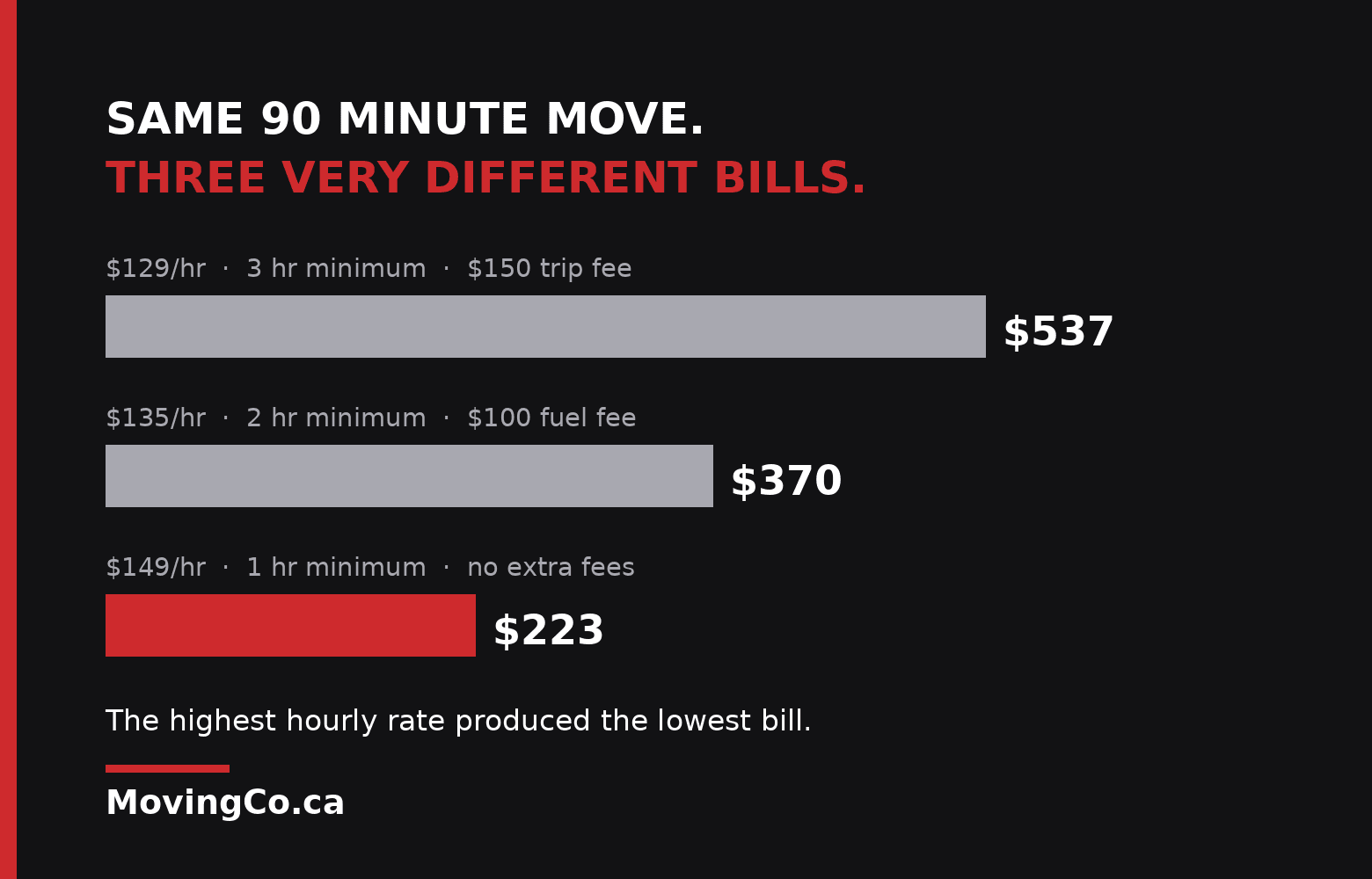
This is the part almost no comparison article does, so here it is with real numbers. Take a one bedroom condo move in downtown Toronto, the most common job in this city. Two movers, loading and unloading, about ninety minutes of actual work.
Scenario A. A company at $129 per hour with a three hour minimum and a $150 trip fee. Ninety minutes of work bills as three hours because of the minimum. Three hours at $129 is $387. Add the $150 trip fee and you are at $537 before tax.
Scenario B. A company at $135 per hour with a two hour minimum, a $100 fuel surcharge, and hourly rounding. Ninety minutes rounds up to two hours. Two hours at $135 is $270, plus $100, so $370 before tax.
Scenario C. Moving Co. at $149 per hour with a one hour minimum, fifteen minute increments after that, and no trip fee. Ninety minutes bills as ninety minutes. That is $223.50 before tax.
The company with the highest sticker rate produced the lowest bill, by a margin of more than two to one against Scenario A. That is not a trick of the example. It is what happens on short moves whenever a minimum charge and a trip fee meet a job that finishes early, and short moves are the majority of moves in a condo city.
The gap narrows as jobs get longer. On a full day move the minimum stops mattering and the hourly rate does most of the work, which is where a $125 per hour company genuinely beats us on price. We would rather tell you that than pretend otherwise. If your move will take eight hours and nobody is charging you a trip fee, shop the hourly rate hard.
How our pricing is built, line by line
We publish the components rather than a single number, because a single number is what lets companies hide things inside it. Here is the whole structure.
- $50 per hour, per mover. That is the labour.
- $49 per hour for the truck. That covers the vehicle, fuel, blankets, dollies, straps and standard coverage.
- Two movers and a truck: $149 per hour. That is $100 of labour plus $49 for the truck. The $149 rate applies to select non-peak dates, and peak-period pricing may vary.
- One mover on their own, no truck: $50 per hour. Useful for loading a container, rearranging a house, or an extra body on a job you are mostly handling yourself.
- Bigger crews are quoted on the call. Larger homes often move faster and cheaper with a third or fourth mover, and we will tell you honestly if that is the case for your job.
- One hour minimum, then 15 minute increments. Go eleven minutes past the hour and you pay for fifteen, not sixty.
- No trip fee, no fuel surcharge, no equipment fee, no stair or elevator fee.
Add it up yourself and it should equal what you were quoted on the phone. If it does not, we got it wrong and we will say so. That is the entire promise, and it is a low bar that a surprising number of companies in this city still cannot clear.
The companies Toronto actually shortlists
Moving Co.
Toronto based, in house crews, 5.0 stars across 145 Google reviews at the time of writing. Rates published above. One hour minimum, fifteen minute billing after that, no separate fees. We handle house moves, condo and apartment moves, small moves, single items, long haul, packing, furniture assembly and junk removal, and we do not subcontract any of it. Available around the clock, which matters more than it sounds in a city where condo boards hand out elevator bookings at seven in the morning or nine at night.
Where we are not the right call: if you need a nationally branded van line with its own overseas freight division, or your building demands a specific carrier, go with that. We would rather lose the job than take one we are not the best fit for.
Let’s Get Moving
One of the largest operations in the city, with a 4.8 rating across more than 2,500 reviews, which is a serious volume of feedback and worth respecting. They advertise insured, GPS tracked trucks and hourly pricing with weekday discounts on moves between the fourth and twenty sixth of the month. They do not publish an hourly rate publicly, so you will need to call for a quote.
Cargo Cabbie
A well established Toronto name, recognised by ThreeBestRated for 2026 and for several consecutive years before that. They are unusually good at publishing educational content about moving costs, which we respect even when it competes with ours. Their public material describes billing in thirty minute blocks starting around $140 per hour. Strong reputation for careful handling and packing.
Miracle Movers
Operating since 1992, serving the GTA and beyond. Their own site states the 2026 market range of $125 to $165 per hour for two movers and $175 to $250 for three, along with a two hour weekday minimum and a three hour Saturday minimum. They also state that they charge a flat fee covering travel time, gas and insurance, calculated from their yard to your pickup and back from your drop off. Worth asking for that number up front so you can compare like with like.
El Cheapo Movers
Voted Best Mover by the Toronto Star from 2019 through 2021. Notably, they bill on a one hour minimum plus quarter hour increments after that, which is the same customer friendly structure we use and genuinely rare in this market. Credit where it is due.
Two Men and a Truck
The largest franchised moving brand in North America, with locations across Canada. The important thing to understand is the franchise structure: every location is independently owned and operated, so pricing, crew quality and policies vary between franchisees. A great experience at one location tells you very little about another. Ask which franchise is servicing your move and read reviews for that specific location.
The charges that surface after you have already said yes
Here is the part of this industry that costs people the most money, and it has nothing to do with the hourly rate. The moment a company has your booking is the moment it has maximum leverage over you, because you have a lease ending, a closing date, and no time to start over. Charges that were never mentioned during the quote have a habit of appearing right about then.
To be fair about it, most of these are disclosed somewhere. They sit in a terms page, or a paragraph in the confirmation email, or they get mentioned in passing on a phone call you were not taking notes on. Disclosed and obvious are not the same thing. The result is the same either way: a bill larger than the number in your head.
These are the charges that exist in the Toronto market. Read the list, then ask about every single one before you pay a deposit.
- Travel or trip fee. Usually calculated from the company yard to your pickup and back from your drop off, so you are paying for driving you never see. Commonly $100 to $300 in this market.
- Fuel surcharge. Separate from the travel fee at some companies, which means it is possible to pay twice for the same driving.
- Equipment or materials fee. Blankets, dollies, straps, wardrobe boxes, shrink wrap, tape. Ask whether any of it is billed.
- Stair fee. Sometimes per flight, sometimes a flat charge above a certain floor in a walk up.
- Elevator or wait time. Charged while the crew stands still because the building gave your slot to someone else.
- Long carry fee. Triggered when the truck cannot park close to the door. In downtown Toronto that is most of the time.
- Heavy item fee. Pianos, safes, treadmills, appliances. Reasonable to charge for, unreasonable to spring on the day.
- Weekend, month end or peak season premium. Often a different rate than the one quoted midweek.
- Minimum charge. The most expensive one on this list and the easiest to miss, because it is not a fee at all. It is hours you did not use, billed as though you did.
- Rounding. A company that rounds up to the next full hour turns ten minutes into sixty.
The one question that flushes all of it out. Ask this, word for word, and write down the answer:
“Other than the hourly rate, what will appear on my final invoice, and will you send me that in writing before I pay a deposit?”
The second half of that question matters more than the first. Anyone will give you a reassuring answer on the phone. A company that will put the complete list in an email is a company that intends to stand behind it. A company that gets vague at the words “in writing” has told you what you needed to know, and it took thirty seconds.
For the record, our answer is that the hourly rate is the entire price. Two movers and a truck is $149 per hour, which is $50 per hour per mover plus $49 per hour for the truck. One hour minimum, then 15 minute increments with no rounding up. No travel fee, no fuel surcharge, no equipment fee, no stair or elevator fee. If your move runs one hour and forty minutes, you pay for one hour and forty five minutes, and that is the last number you will hear from us. That $149 rate applies to select non-peak dates. Peak-period pricing may vary.
What white glove actually means, and how to tell if you are getting it
White glove is the most abused phrase in this industry. Everyone claims it. Here is what it should actually mean on the day, and these are things you can verify by asking three questions on the phone.
Floor and door protection goes down before anything moves. Runners on hardwood, corner guards on door frames, blankets on bannisters. If a crew starts carrying before they start protecting, you have hired the wrong people.
Everything gets wrapped, not just the expensive things. Moving blankets and shrink wrap on every piece of furniture, not the three items you specifically mentioned. Drawers taped or emptied. Glass and mirrors in proper cartons rather than a blanket and hope.
Disassembly and reassembly are part of the job. Bed frames, table legs, mirror mounts. The hardware goes into a labelled bag that is taped to the piece it came from, so nothing gets hunted for at eleven at night in a new house.
The crew is uniformed, named and employed. You should know who is coming. Subcontracted day labour has no stake in your dining table and no accountability the following week.
Placement, not dumping. Boxes go in the room written on the box. Furniture goes where you want it, and if you change your mind once, it gets moved again without a sigh.
How to choose, in the right order
- Get the hourly rate and the minimum in the same sentence. “What is your rate, and what is the minimum charge?” A company that answers one but not the other is answering strategically.
- Ask what else appears on the invoice. Word it exactly like this: “Other than the hourly rate, what else will be on my final bill?” Then listen for travel, fuel, equipment, stairs, heavy items, and materials.
- Ask about the billing increment. “After the minimum, do you bill by the hour, half hour, or quarter hour?” The difference between quarter hour and rounding up to the next hour is real money on a short move.
- Ask whether the crew are employees. Then ask whether they are covered by WSIB. Both answers should be immediate and confident.
- Ask what their coverage actually pays. Basic coverage across this industry is $0.60 per pound per article, which on a sixty pound television is thirty six dollars. Ask what the upgrade to full replacement value costs.
- Check the reviews with the dates showing. A 4.9 built five years ago and coasting is not the same as a 4.9 built this year. Read the most recent ten.
- Confirm it in writing. Email, text, anything with a timestamp. A verbal quote is worth what you paid for it.
Red flags that should end the conversation
- A quote with no in home or video walkthrough on a large move. Nobody can price a four bedroom house from a two minute phone call, and a number produced that way exists to be revised upward on the day.
- A large deposit before moving day. A modest booking deposit is normal. Hundreds of dollars up front is not.
- Cash only, or a heavy push toward cash. No paper trail is the point.
- No physical address, or an address that is a mailbox. Look it up before you book.
- The company name on the truck does not match the company you called. That is a broker, and your move has been sold on.
- Reluctance to state the minimum charge. Every time, without exception, this is because the minimum is the surcharge.
We wrote a longer piece on this specific problem in our guide to moving scams and red flags in Ontario, which covers the hostage load situation and what to do if it happens to you.
Which company is right for your specific move
Studio or one bedroom condo, downtown. This is the job where minimums and trip fees do the most damage, because the work itself rarely exceeds two hours. Prioritise a one hour minimum and short billing increments over the headline rate. Our full breakdown lives in the cost to move a one bedroom apartment in Toronto guide.
Three or four bedroom house. Now the hourly rate dominates and the minimum is irrelevant. Get at least three quotes, insist on a video walkthrough, and compare the all in figure rather than the rate. See house moves.
A single heavy item. Pianos, safes, treadmills, hot tubs. Do not hire a general crew for these. Ask specifically how many of these they did last month. See single item moves and our guide on moving a piano and other heavy items.
Leaving the province. Different game entirely. Ask whether it is a dedicated truck or a shared load, and what the delivery window is. A shared load can arrive anywhere in a two week spread. See long haul moves.
Condo to condo. The move is easy. The elevator booking, certificate of insurance and loading dock window are what will sink you. Read the condo moving guide before you book anything.
We serve the whole GTA, including Toronto, Mississauga, Vaughan, Markham and Brampton.
Frequently asked questions
Who is the best moving company in Toronto in 2026?
There is no single answer that fits every move, and any guide claiming otherwise is selling something. For short local moves where minimum charges dominate, the best company is whichever one has a one hour minimum, short billing increments and no trip fee. Moving Co. meets all three and holds a 5.0 rating across 145 Google reviews. For very long full day moves, compare hourly rates hard, because that is where a lower rate genuinely wins.
How much do movers cost in Toronto?
In 2026 the Toronto market runs $125 to $165 per hour for two movers and a truck, and $175 to $250 for three. Moving Co. charges $149 per hour for two movers and a truck, which breaks down as $50 per hour per mover plus $49 per hour for the truck. A single mover without a truck is $50 per hour. The $149 rate applies to select non-peak dates, and peak-period pricing may vary.
Why do some cheap movers end up costing more?
Three reasons, and they compound. A three hour minimum on a ninety minute job adds ninety minutes you did not use. A trip or fuel fee of $100 to $300 does not appear in the hourly rate. And rounding up to the next full hour turns eleven extra minutes into a full hour of billing. A $129 per hour company with all three can finish more expensive than a $149 per hour company with none of them.
What is a normal minimum charge for Toronto movers?
Two hours on weekdays and three hours on Saturdays is the most common structure in this market. A one hour minimum is uncommon and works in your favour on small moves. Always ask for the minimum in the same breath as the rate.
Do Toronto movers charge extra for stairs or elevators?
Many do. Some charge per flight, some charge a flat fee for walk ups above a certain floor, and some build elevator wait time into a separate line. Moving Co. does not charge extra for stairs or elevators. Ask any company you are considering, because on a third floor walk up this single answer can move your bill by a hundred dollars or more.
Does moving insurance actually cover my furniture?
Basic coverage across the Canadian moving industry is $0.60 per pound per article. On a sixty pound television that pays out thirty six dollars, regardless of what the television cost. Full replacement value coverage is available and is worth asking about on any move containing something you would be genuinely upset to lose. Our full explainer is in the moving insurance in Canada guide.
How far in advance should I book a mover in Toronto?
Two to four weeks for a regular weekday. Six weeks or more if you are moving on the last weekend of the month, the first of the month, or any day in late June through early September, which is when this city moves. Last minute bookings during peak periods carry higher rates across the entire industry.
Should I tip my movers?
It is customary in Canada but not obligatory. Most people tip between ten and twenty dollars per mover for a half day and more for a full day or a difficult job. Full detail in our guide on how much to tip movers in Canada.
The honest conclusion
If you take one thing from this guide, take this: stop comparing hourly rates and start comparing final invoices. Ask every company the same four questions. What is the rate. What is the minimum. What else goes on the bill. What is the billing increment after the minimum. Write the four answers in a row and the right choice usually becomes obvious without anyone needing to argue for it.
We think that comparison lands in our favour most of the time, which is why we are comfortable publishing our full pricing structure and pointing you at our competitors’ sites to check theirs. A company that will not tell you its minimum charge before you book has already told you something important.
If you want a straight number for your move, call us at 905-752-7787 or request a quote. We will give you the rate, the minimum and the likely hours on the phone, and we will put it in writing.