
How to Move a Piano, Safe, or Heavy Item (and When to Call a Pro)

A practical guide to moving pianos, safes, pool tables and other heavy items: how it is actually done, the equipment, the stairs problem, what it costs, and when to call professionals.
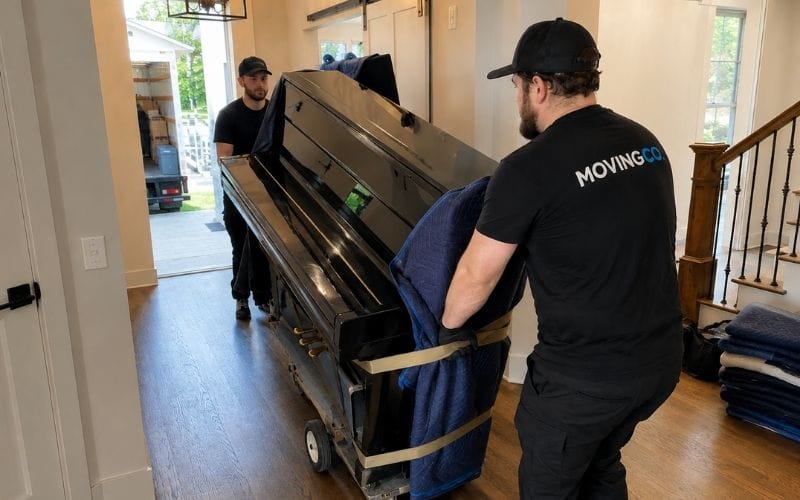
Moving a piano, a safe, or any object over a few hundred pounds is not a job of strength, it is a job of technique and equipment. An upright piano weighs between roughly 150 and 450 pounds, a grand can pass 1,000, and a full-size gun safe can weigh as much as a small car. The people who move these things safely do it with skid boards, straps, and a plan for the weight, not with four friends and good intentions. This guide explains how heavy items are actually moved, what equipment the job requires, why stairs are the real danger, what it costs, and the clear point where you should stop and hire professionals.
We move specialty items constantly, and the injuries and disasters we hear about almost always come from people underestimating one thing: heavy objects do not just resist lifting, they punish mistakes. A piano that starts to tip does not stop, a safe that shifts on a staircase can crush a leg or destroy the stairs, and both are far more expensive to replace than to move. So read this whether you plan to do it yourself or just want to understand what a good crew brings to the job.
Why pianos and safes are uniquely hard to move
Heavy specialty items combine three problems that ordinary furniture does not. First is the sheer weight, which is often concentrated and unevenly distributed, so the object does not balance the way a dresser does. A piano carries much of its weight in the cast-iron plate and the action, and a safe is essentially a solid block, so both are top-heavy or dense in ways that make them want to tip. Second is the value and fragility. A piano is a precision instrument with thousands of moving parts, and a hard knock can damage the action, the soundboard, or the finish in ways that are expensive or impossible to fix. Third is the danger to people and property. An object this heavy, moving even slowly in the wrong direction, can break bones, crush hands, and destroy floors, stairs, and doorframes. That combination is why these items are their own category, handled differently from everything else in a move.
How much do pianos and heavy items weigh?
Knowing the weight tells you what you are dealing with, because the plan changes completely as the number rises. A spinet or small upright piano runs roughly 150 to 300 pounds. A full-size upright or console is often 300 to 500 pounds. A baby grand is commonly 500 to 650 pounds, and a full concert grand can reach 900 to 1,200 pounds. A residential floor safe or gun safe ranges from a few hundred pounds to well over 1,000 for a large model. A slate-bed pool table can weigh 700 to 1,000 pounds, most of it in the slate. Once an object passes roughly 300 pounds, it is beyond what people should be lifting and carrying by hand, and it needs to be rolled and controlled with equipment rather than muscled. Above 500 pounds, and on any stairs, it is squarely professional territory.
The equipment used to move heavy items
Professionals make heavy moving look manageable because the equipment does the work that strength cannot. A piano board or skid board is a padded board that a grand piano is strapped to on its side, turning an awkward shape into a manageable one. Heavy-duty moving straps and a lifting harness let two or more people share and control the load with their legs and body weight rather than their backs. Four-wheel dollies and piano dollies roll the object so it is pushed, not carried, on flat ground. Ramps bridge steps and thresholds so the object rolls rather than being lifted over them. Stair-climbing dollies, some motorized, control descent down a staircase. Furniture blankets and padding protect the finish and the building. And floor protection guards against the point loads that a heavy wheel or foot puts on a floor. Trying to substitute people for this equipment is exactly where injuries and damage happen.
How to move an upright piano
An upright piano is the most common piano move and, on a single level with no stairs, the most approachable, though it is still a job for several strong people with the right gear, never a solo effort. Start by closing and securing the keyboard lid and locking the wheels or casters, which are decorative on many pianos and not built for real travel, so do not rely on rolling it far on its own casters. Wrap the piano in moving blankets, covering the corners and the finish, and secure the blankets. Then, with a person at each end and using a four-wheel piano dolly, tilt the piano just enough to get the dolly underneath and roll it, keeping it upright and moving slowly, with a spotter watching the path. Through doorways, measure first and go slowly, because the corners are where the finish gets gouged. The moment stairs enter the picture, the difficulty and danger rise sharply, and that is the point to bring in professionals with stair equipment.
How to move a grand piano
A grand piano is not moved upright, it is partially disassembled and moved on its side, which is why it is genuinely a job for a trained crew. The process is to lower the lid and lock it, remove the music rack, then carefully remove the legs and the pedal lyre, which are structural but detachable, wrapping each separately. The piano is then tilted onto a padded piano board, its long side, and strapped securely to the board, which supports the case and protects the rim. On the board it can be rolled on a dolly, guided by several people, and manoeuvred through the home. Reassembly reverses the process at the destination. This is delicate, heavy, and unforgiving work, and it is the clearest example of a move where the right answer for almost everyone is to hire specialists rather than attempt it, because the cost of a mistake, to the instrument and to the people, is very high.
Pianos and stairs: the real danger
Stairs are where piano moves go wrong, and it is worth being blunt about it. A piano on a staircase is a heavy object on an incline, and if it gets away from the people controlling it, there is no stopping it, which is how movers and homeowners get seriously hurt and how staircases get destroyed. Descending is more dangerous than ascending, because gravity is working against you. Professionals handle stairs with stair-climbing dollies, multiple crew members positioned to control the load, and sometimes by using a different route entirely, such as hoisting the piano through a window or balcony on the upper floor when the stairs are too tight or too steep. If your piano move involves anything more than a couple of shallow steps, this is not a place to improvise. It is the single strongest reason to hire a crew that moves pianos regularly.
How to move a safe
A safe is dense, top-heavy when open, and utterly unforgiving of a fall, so it is handled with the same seriousness as a piano. Keep the safe locked and the door secured so it cannot swing open and shift the weight mid-move. Because a safe is essentially a solid block, it is moved on a heavy-duty dolly rated for the weight, tilted onto the dolly by several people using straps and leverage rather than lifting. Floor protection is essential, because a loaded safe on a small wheel puts enormous pressure on one point and will dent or crack flooring. Stairs with a safe are extremely dangerous and often require a stair-climbing dolly and a full crew, or a different route. The two rules that matter most are never get any part of your body underneath or downhill of a safe in motion, and never try to catch a safe that starts to go, because you cannot, and the attempt is how people are badly hurt. For anything above a few hundred pounds or any stairs, this is professional work.
Other heavy specialty items
Pianos and safes are the headline cases, but the same principles apply to a range of heavy items that catch people out. A slate pool table must be disassembled, because the slate bed comes in heavy sections that are moved separately and the table is reassembled and re-levelled at the destination, a job for specialists if you want it to play true afterward. Large exercise equipment and treadmills are heavy and awkward and often need partial disassembly. Hot tubs are extremely heavy, need to be drained and moved on their side with special equipment, and are a genuine specialty move. Large appliances, commercial equipment, and heavy stone or metal furniture all fall into the category where equipment and technique matter more than strength. The common thread is that all of them reward the same approach: assess the weight honestly, use the right rolling and lifting equipment, protect the floors, plan the route including any stairs, and know when the job has crossed into professional territory. We handle these as their own category through our single item and specialty moving service.
Protecting the item and your home
Whatever the heavy item, two things always need protecting: the object and the building. Wrap the item in moving blankets to guard the finish, and pad any part that will bear against a strap or a wall. For the building, lay down floor protection along the entire path, because heavy point loads from wheels and feet are what scratch and crack floors, and pad the doorframes and stair edges, which take the impact when a heavy object is guided through a tight space. In a condo, protecting the common areas and the elevator matters even more, since damage there is your liability, which is why buildings require movers to carry insurance. The most valuable specialty items, pianos and antiques especially, should also have their value declared for coverage rather than relying on basic per-pound valuation, which we cover in our guide to moving insurance in Canada.
When to absolutely call a professional
There is a clear line, and it is worth stating plainly. Call professionals for any grand piano, without exception, because the disassembly and side-mounting are specialist work. Call professionals for any piano or safe that must go up or down stairs, because stairs are where the serious injuries and property damage happen. Call professionals for anything over roughly 500 pounds, for slate pool tables and hot tubs, and for any item whose value or fragility means a mistake is catastrophic. You can reasonably move a small upright piano on a single level with enough strong people and the right dolly, and you can move a modest safe on flat ground the same way, but the moment weight, stairs, value, or tight access rise, the math tips hard toward hiring a crew that does this every week. The cost of professional specialty moving is small next to the cost of a destroyed instrument, a cracked staircase, or a hospital visit.
What does it cost to move a piano or heavy item?
Specialty moving is priced on the item, the weight, the access, and the distance, rather than a flat rate, because a small upright on a ground floor and a grand piano down two flights of stairs are entirely different jobs. The factors that raise the price are weight, stairs and difficult access, long carries, and distance. Because the cost of damage to a piano, a safe, or a home far exceeds the cost of moving them properly, specialty moving is one of the clearest cases where paying for the right crew is the economical choice, not the expensive one. The honest way to price it is a proper assessment of the specific item and the specific access at both ends, which is what we do before quoting a specialty move. You can start with a free quote.
Do pianos need tuning after a move?
Yes, almost always. A piano should be tuned after a move, but not immediately. The instrument needs time, usually a few weeks, to settle and acclimatize to the temperature and humidity of its new home before tuning, because tuning it before it has adjusted means it will drift out again as it settles. The move itself, even done perfectly, changes the environment around the instrument, and pianos are sensitive to changes in humidity in particular. So plan to give the piano two to four weeks in its new spot, ideally away from direct heat, cold, and sunlight, and then have it tuned. This is normal and expected, not a sign that anything went wrong in the move.
Preparing the room and the route before moving day
Much of what makes a heavy-item move go smoothly happens before anyone touches the object, in planning the path it will travel. Walk the entire route from where the item sits to where the truck will park, at both the origin and the destination, and measure the tight points: doorways, hallway widths, stair turns, and the clearance around corners. A piano or safe that will not fit through a doorframe needs that discovered in advance, not with the object halfway out of the room. Clear the path completely, removing rugs that can slide, furniture that narrows the route, and anything underfoot, and plan where doors need to be held open or removed from their hinges to gain an inch. Decide where the item will end up in the new space before it arrives, so it is set down once in its final position rather than shuffled around, because every extra move of a heavy object is another chance for injury or damage. For a piano especially, choose the destination spot thoughtfully, away from heating vents, exterior walls, and direct sunlight, since those conditions are hard on the instrument over time. Good planning turns a heavy move from a struggle into a controlled, deliberate process.
Caring for a piano’s climate after the move
A piano is a wood-and-metal instrument that responds to its environment, and where you place it and how you treat it after the move affects how well it holds up. The two enemies are temperature swings and humidity changes, both of which cause the wood to expand and contract, stressing the soundboard and knocking the instrument out of tune. Keep a piano away from heating and cooling vents, fireplaces, exterior walls that get cold, and windows with direct sun. Aim for a stable, moderate humidity, since very dry indoor air in a Canadian winter can crack the soundboard over time and very humid air can swell it, and many piano owners use a room humidifier or a dedicated piano climate-control system to keep conditions steady. After the move, give the instrument a few weeks to settle before tuning, as covered above, and then keep it on a regular tuning schedule. Treating the piano well after the move protects the investment you just paid to relocate, and it is the kind of detail that separates people who keep a piano in good shape for decades from those who let it slowly deteriorate.
Renting the equipment and doing it yourself: the reality
People sometimes decide to move a piano or safe themselves and rent the equipment to do it, and it is worth being honest about what that actually involves. You can rent a piano dolly, straps, and even a stair-climbing dolly from equipment rental outlets, and for a small upright on a single level with several strong, capable helpers, that can work. But the equipment is only half the job. The other half is technique and coordination, knowing how to tilt and balance the load, how to communicate as a team so everyone moves together, how to control the object on a ramp or a turn, and how to read when something is going wrong before it does. That knowledge is what professionals bring that a rental cannot, and it is exactly what is missing in the stories of dropped pianos and crushed hands. The rental math also tends to be less favourable than it looks once you add the equipment, the risk to the item and the home, and the fact that a single mistake costs far more than the whole professional move. For a small item on flat ground the do-it-yourself route is defensible. For anything heavy, valuable, or involving stairs, the equipment alone does not close the gap, and the sensible choice is a crew that does this regularly.
Insuring a piano or other high-value item
Heavy specialty items are usually also valuable items, and the basic coverage that comes with a move does not begin to reflect that value, which is a gap worth closing before the move rather than discovering after. A mover’s basic liability is calculated by weight at a low rate per pound, so a grand piano worth tens of thousands of dollars might be covered for only a few hundred dollars under basic valuation, nowhere near its replacement cost. To protect a piano, a safe, an antique, or any high-value item properly, declare its value specifically and choose replacement value protection or a separate policy that reflects what it is actually worth. Document the item with photographs and any appraisal or purchase records before the move, so its condition and value are established. And understand the exclusions, since some coverage limits or excludes items of extraordinary value unless declared in advance. We explain the whole subject, released value versus replacement value and how to declare high-value items, in our guide to moving insurance in Canada. For a valuable instrument or safe, getting the coverage right is as important as getting the physical move right.
Moving other instruments and delicate valuables
Pianos are the heaviest instruments, but a home often holds other valuables that need the same careful thinking, even when they are not heavy. Other large instruments, an organ, a harp, a double bass, benefit from the same principles as a piano, protection of the delicate mechanism, careful handling, and in many cases professional moving, since they are both fragile and expensive. Smaller instruments like guitars and violins travel best in their hard cases, ideally carried with you rather than loaded on the truck, because they are irreplaceable and easily crushed. Grandfather clocks are a classic hidden hazard, since they contain delicate weights and a pendulum that must be secured or removed before moving or the mechanism is damaged. Chandeliers, large mirrors, and fine art are fragile in ways their weight does not suggest and deserve custom crating or careful padding and upright transport. The through-line with all of these is that value and fragility, not just weight, determine how much care an item needs, and the most valuable things in a home are often not the heaviest. Identify these items early, decide which travel with you and which need special handling, and declare the valuable ones for coverage, so nothing irreplaceable is treated as an ordinary box on move day.
Frequently asked questions about moving pianos and heavy items
Can I move a piano myself?
You can reasonably move a small upright piano on a single level with several strong people and a proper piano dolly, moving slowly and keeping it upright. You should not attempt a grand piano, which requires partial disassembly and side-mounting on a piano board, or any piano that must go up or down stairs, because stairs are where serious injuries and damage happen. When weight, stairs, value, or tight access are involved, hire professionals who move pianos regularly.
How much does a piano weigh?
A small upright runs roughly 150 to 300 pounds, a full-size upright 300 to 500, a baby grand 500 to 650, and a full concert grand can reach 900 to 1,200 pounds. Once an object passes about 300 pounds it is beyond safe hand-carrying and needs to be rolled and controlled with equipment. Above 500 pounds, or on any stairs, it is professional territory.
How do professionals move a grand piano?
They lower and lock the lid, remove the music rack, then carefully remove and wrap the legs and pedal lyre, tilt the piano onto its long side on a padded piano board, and strap it securely to the board. On the board it rolls on a dolly, guided by several crew members, and it is reassembled at the destination. This is delicate, heavy work that is genuinely specialist, which is why moving a grand piano yourself is not advisable.
How do you move a heavy safe safely?
Keep the safe locked and the door secured, tilt it onto a heavy-duty dolly rated for the weight using straps and leverage rather than lifting, and protect the floor, because a loaded safe puts enormous pressure on a small wheel. Never put any part of your body underneath or downhill of a safe in motion, and never try to catch one that starts to go. Stairs with a safe are extremely dangerous and usually require a stair-climbing dolly and a full crew or a different route.
Why are stairs so dangerous when moving a piano?
A piano on stairs is a heavy object on an incline, and if it gets away from the people controlling it there is no stopping it, which is how movers and homeowners get seriously hurt and staircases get destroyed. Descending is more dangerous than ascending because gravity works against you. Professionals handle stairs with stair-climbing dollies, multiple crew positioned to control the load, and sometimes a different route such as hoisting through a window, which is why stairs are the strongest reason to hire specialists.
Does a piano need to be tuned after moving?
Yes, almost always, but not right away. Give the piano a few weeks to settle and acclimatize to the temperature and humidity of its new home before tuning, because tuning it before it has adjusted means it will drift out again. Place it away from direct heat, cold, and sunlight, wait two to four weeks, and then have it tuned. This is normal and not a sign that anything went wrong in the move.
How much does it cost to move a piano?
It is priced on the specific item, its weight, the access including any stairs, the length of the carry, and the distance, rather than a flat rate, because a small upright on a ground floor and a grand down two flights are very different jobs. Because the cost of damage to the instrument or the home far exceeds the cost of moving it properly, professional specialty moving is usually the economical choice. The accurate way to price it is an assessment of the item and the access at both ends.
Can you move a pool table or hot tub?
Yes, but both are specialty moves. A slate pool table must be disassembled, because the slate bed comes in heavy sections moved separately, and it is reassembled and re-levelled at the destination for it to play true. A hot tub is extremely heavy, needs to be drained and moved on its side with special equipment. Both are jobs where the right crew and equipment matter far more than strength, and both are handled as specialty items rather than ordinary furniture.
The bottom line on moving heavy items
If there is one principle that ties this whole guide together, it is that heavy specialty moving is about control, not strength. The people who move pianos and safes for a living are not simply stronger than everyone else, they control the object at every moment through equipment, technique, and planning, so it never gets the chance to become dangerous. That is why the honest advice keeps landing in the same place: a small upright on flat ground with the right dolly and enough capable help is a reasonable thing to move yourself, but a grand piano, a heavy safe, a slate pool table, or anything at all on a staircase is a job where the cost of losing control, to your body, your home, and the item, is simply too high to gamble on. Assess the weight and the access honestly, protect both the item and the building, declare the value of anything precious for proper coverage, and know where the line is between what you can safely handle and what calls for a crew that does this every week. Respecting that line is not an admission of weakness, it is the same judgment the professionals use, and it is what keeps a heavy move from turning into an expensive or painful mistake.