
Moving Heavy Furniture in Toronto: Pianos, Safes and Large Pieces

Moving heavy furniture in Toronto comes down to the route the piece has to travel: the service elevator in a condo tower, the stairs of a walk-up over a shop on the Danforth, the narrow front hall of a Victorian semi. Measure that route before you book, describe the piece accurately, and give the job
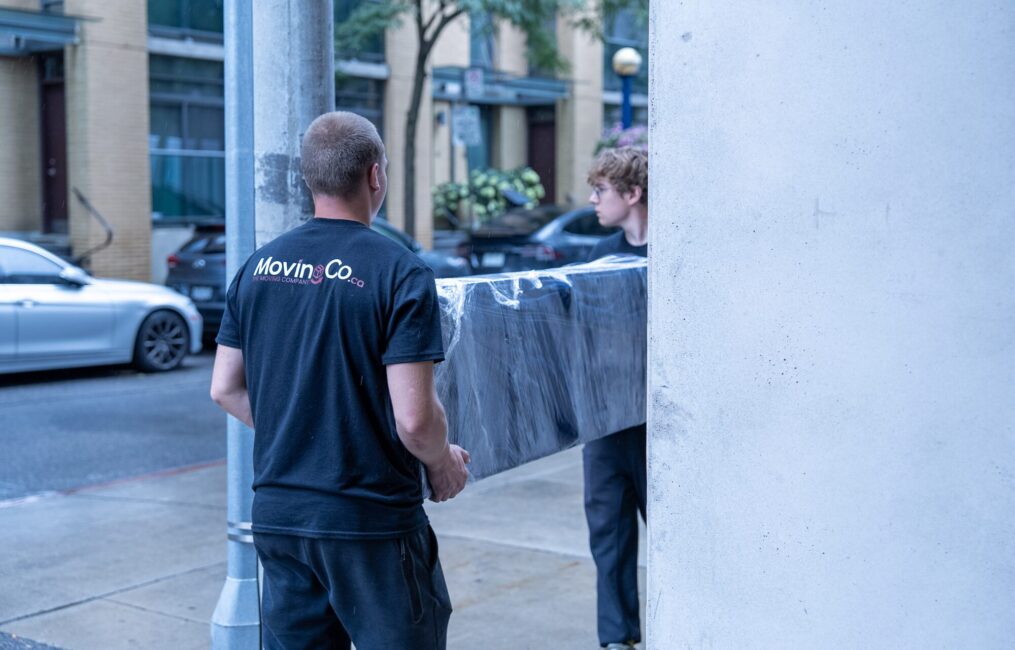
Moving heavy furniture in Toronto comes down to the route the piece has to travel: the service elevator in a condo tower, the stairs of a walk-up over a shop on the Danforth, the narrow front hall of a Victorian semi. Measure that route before you book, describe the piece accurately, and give the job to a crew with the right equipment. At Moving Co., pianos have their own flat rates, safes and art are quoted on request, and a single item moved within the city is listed at $99 flat on our pricing page.
Lifting technique and typical weights are covered in our general guide to moving a piano, safe or heavy item, and piano prices by type and access are on our Toronto piano movers page. This article deals with the buildings: elevators, stairwells, floors, parking, and the point where a specialist crew stops being optional.
How heavy pieces are priced
Heavy items are priced one of three ways at Moving Co.: a flat rate, a quote, or the hourly rate. Knowing which one applies to your piece saves a round of questions on the phone.
| Piece | What makes it hard in a Toronto building | How it is priced |
|---|---|---|
| Upright piano | Heavy for its footprint; stairs and tight turns | Flat rate, from $250 at ground level |
| Baby grand piano | Legs and lyre come off and it travels on its side on a piano board | Flat rate, set by the instrument and the stairs |
| Gun safe or other safe | Dense, top-heavy, hard on floors and stair treads | Quoted on request |
| Art | Fragile, and often worth far more than per-pound coverage | Quoted on request |
| Hot tub | Size, weight and the route to the yard | Quoted on the call |
| Sectionals, armoires, marble tables, treadmills, appliances | Length, disassembly and stairs | $99 flat as a single item in the city; hourly as part of a full move |
The piano figures are planning ranges for typical access, not quotes. Pianos run from $250 for an upright at ground level up to $1,500 for a concert grand with difficult stairs, and a short video of the route is what turns a range into a real estimate.
As part of a full move, everything in the bottom row runs on the clock: $149 an hour for two movers and a truck, with a one-hour minimum and 15-minute increments after that. That rate applies to select non-peak dates, and peak-period pricing may vary. A third mover for a heavy carry is quoted on the call. Stairs and elevators cost nothing extra, simple disassembly is included, and complex disassembly is $25. The truck, blankets, dollies and straps come with the rate, so a heavy piece carries no equipment fee. The full rate card is on our Toronto moving prices page.
Condo service elevators: measure the cab, then check the rated load
In a tower, the elevator decides what is possible. Before anyone quotes a heavy piece out of a condo, two things need checking: the size of the service elevator and the load it is rated to carry. Ask the property manager or concierge for the figures, then measure anyway, because the size on paper and the space inside the pads are not the same.
- The door opening. Clear width and height with the doors fully open. A piece can fit inside the cab and still fail at the door.
- The cab. Interior width, depth and height, measured inside the protective pads if the building hangs them for moves.
- The piece. Length, depth and height, measured with the legs off if they unscrew.
- The rated load. Usually shown on a plate inside the cab, often in kilograms. Multiply by 2.2 to get pounds.
If a piece is longer than the cab is deep, it has two ways in. It can stand on end, which only works if it is shorter than the cab’s interior height, or it can tilt in at an angle, which only works for slim pieces. For the rated load, add up the piece, the dolly or board it rides on, and the people travelling with it. If that total comes close to the rating, tell the building before move day so the plan changes on paper rather than at the loading dock.
The elevator also has to be yours for the move. Bookings, permitted hours, padding and damage deposits are set building by building. In a condo they are often written into the corporation’s rules, which the Condominium Authority of Ontario describes as regulating day-to-day activities in a condo community. Owners can ask the corporation for a copy with the CAO’s Request for Records form; tenants should ask their landlord. Read the section on moves before you choose a date, because a heavy piece needs the whole route at once: dock, corridor, elevator and the hallway on your floor.
On condo jobs we provide the certificate of insurance your building asks for, naming the building, before move day, and a second one if the building at the other end wants its own. The crew works inside your booked elevator window and protects the hallways and the elevator cab. Our guide to condo elevator bookings, building rules and parking covers the paperwork side.
When a piece will not fit the cab, you have three real options: it comes apart, it goes down the exit stairs if the building allows that, or you decide it is not worth the trip. A sectional usually separates. A one-piece sofa with a fixed frame usually does not, and twenty floors of stairwell adds up quickly on an hourly job.
Walk-ups, Victorian semis and stairs that turn
Much of Toronto’s older housing was built long before anyone owned a sectional. The bay-and-gable house, common throughout the older parts of the city, went up in large numbers until the late 1890s, mostly as semis and row houses. Most late-19th-century semi-detached examples are 3.7 to 7.6 metres wide (12 to 25 feet), and in the narrowest the stairs to the second floor start in the front hall. That is the geometry a piano or an armoire has to beat: a front door, a short hall, and a stair that climbs straight up and often turns at the top.
Apartments above shops on Queen Street West, College Street, the Danforth and Roncesvalles have their own version. The street door opens onto a steep, narrow stair, sometimes with a landing halfway and a low ceiling where the stair turns. Some of these stairwells have been narrowed over the years by drywall, new railings or a renovation, so a couch that went up before the work may not come back down after it.
Measure the tightest point, which is rarely the front door. It is usually the turn: the stair width at the landing, the headroom where the ceiling drops, and the room a long piece needs to pivot. Measure a sofa’s depth and height with the legs off, because it will go through the turn on its back or on end. Taking an interior door off its hinges buys a little width at the top of the stairs.
Stairs cost nothing extra with us. On an hourly job you pay for the time the carry takes, so a third-floor walk-up costs more than a ground-floor flat only because it takes longer. Our guide to moving out of a Toronto walk-up covers the rest of a walk-up move.
Moving a safe: basements, upper floors and bolted-down units
A safe is the least forgiving piece in most homes. Its weight sits in a small, dense block, it gets top-heavy the moment it tilts, and nobody can catch it once it starts to go. In Toronto homes safes tend to end up in awkward places: a basement under a steep stair, a bedroom closet on the second floor, a condo den twenty storeys up. Gun safes and other safes are specialty handling at Moving Co. and are quoted on request, because the model, the weight and the route change the job so much.
Before you ask for a quote:
- Find the model number. The manufacturer’s specifications give the real weight and dimensions. A guess can be hundreds of pounds out, and the crew and equipment are chosen from that number.
- Empty it completely. Papers, jewellery and cash travel with you. Firearms come out too, and moving them falls under federal rules: the RCMP says owners of restricted or prohibited firearms who are moving to a new address need an Authorization to Transport from their provincial Chief Firearms Officer.
- Check for anchor bolts. If the safe is bolted to the floor, say so when you book, so unbolting is planned rather than discovered.
- Keep the door shut and locked for the move, and make sure the combination or key is with you at the other end.
Basements are where safe moves slow down. Basement stairs in older Toronto houses are often steep, with a turn at the bottom and a beam or duct overhead, and the safe has to come up them under control, on a stair climber with straps, one step at a time. Going down is the riskier direction, because the load is pulling toward the people below it.
Upper floors raise a different question. Before a very heavy safe goes into a second-floor bedroom of an older house for the first time, ask a contractor or engineer about the floor framing. In a condo, ask the property manager whether the building has a procedure for very heavy items, then check the elevator’s rated load as described above.
Sectionals, armoires and pieces that won’t fit
Not every problem piece is heavy. Plenty of moves stall on furniture that weighs less than a fridge but is longer than the turn in the stairs.
- Sectionals separate at the connectors, and each section travels on its own. Sleeper sofas are the exception that catches people out: the steel folding mechanism makes them far heavier than they look.
- Armoires and wardrobes often have a crown that lifts off, doors that come off their hinges and shelves that slide out. That turns one tall, top-heavy box into a shell that clears a low ceiling.
- Flat-pack wardrobes and particleboard units are a judgment call. The federal Office of Consumer Affairs explains that some items, such as fibreboard furniture, have what is called inherent vice: they are meant to be assembled once and left in place, and movers may ask for a waiver of liability when they see them. Some come apart and go back together fine. Others strip their fittings and never stand straight again.
- Marble and glass tops come off the base and travel on edge in padding. If you pack them yourself, the same federal page says special-care items such as glass and marble are at the owner’s risk, and the mover is unlikely to be liable for damage to items that were not packed professionally.
- Treadmills and home gym equipment usually live in basements. Some fold or come apart and some do not, so check the manual for your model before moving day.
- Dining tables lose their leaves and usually their legs, and a long top goes through doorways on its side.
Simple disassembly and reassembly is included with Moving Co., and complex disassembly is $25. If you would rather have a piece taken apart and rebuilt properly at the other end, our furniture disassembly and assembly service handles it.
When a piece will not go, stop pushing. Check whether more of it comes apart, look for another route such as a back door, and measure again. If nothing works, the choice is between leaving it behind, selling or donating it, or having it hauled away. Forcing a piece through a frame turns a moving problem into a repair bill for the frame, the wall and the piece. When the job is one heavy piece and nothing else, our single item and furniture moving service is the way to book it.
Protecting floors, walls and the building
With heavy pieces, the building carries as much risk as the furniture. The Office of Consumer Affairs guidance mentioned above suggests asking movers to use drop cloths or runners at both locations to protect floors and rugs. For a piano or a safe, treat that as the starting point.
- Hardwood and tile. A loaded dolly puts the whole weight of a safe or piano on a few small wheels. Blankets do not spread that load, so the path needs hard protection under the wheels.
- Stair nosings, door frames and corners. These take the knocks when a long piece pivots. Padding them costs minutes. Repairing a chipped plaster corner in a century house costs a great deal more.
- Condo common areas. On condo jobs we protect the hallways and the elevator cab. Photograph the lobby, the corridor and the cab before and after anyway, because your deposit depends on what the building thinks happened.
- Winter. Salt, slush and ice are part of most Toronto moves between December and March. Clear and salt the front steps the night before, put a mat inside the door, and keep a towel handy for dolly wheels before they cross hardwood.
Take photos along the route at both addresses before the crew arrives, and report any damage right away: the same federal guidance warns that claims often have tight deadlines, commonly 30 days for a local move.
Parking and the carry to the truck
Every metre between the truck and the door is carried or rolled, and with a heavy piece every extra metre is slow work. A loading dock or a driveway is ideal. On a residential street, the closest legal spot is the next best thing.
The City of Toronto’s temporary on-street parking permits are resident and visitor permits for permit-parking streets, valid only where space is available and restricted by vehicle type, so they are not a way to hold a spot for a moving truck. Ask your building about the loading dock or a legal loading spot, and read every sign on the block, since stopping rules on main streets change through the day.
Older streets in the Annex, Leslieville or Little Italy often have a laneway behind the houses. A laneway can put the truck much closer to a back door or garage, but check its width, the overhead wires and whether a neighbour’s car usually blocks it.
Pianos in Toronto buildings
Pianos get their own flat rate and their own equipment. We move more than 30 pianos a month, and our crews carry piano boards, piano dollies and stair climbers as standard. The Toronto problems are the ones covered above, with a twist for each type. An upright is long and heavy for its size, so the door opening, the cab depth and the rated load all matter. A grand travels on its side on a padded board after the legs and lyre come off, so the cab has to be longer than the piano, or it goes by the stairs.
To price a piano move, send the piano type, the floor it is on now, the floor it is going to and the elevator situation at both ends through our quote request page. The flat rate follows from those four answers. Tuning, the full price table by access and how grands are taken apart are on the piano page linked at the top of this article.
When to hire a crew and when friends will do
Plenty of heavy furniture can be moved by a few capable friends. The jobs that need a crew usually involve stairs, real value, a tight turn or a building that wants paperwork.
| Situation | Friends and a rented dolly? | Why |
|---|---|---|
| Upright piano, ground floor to ground floor, wide doors, short flat carry | Possible | No stairs, so the risks are the floor, the door frames and fingers |
| Any piano on stairs, or any grand piano | No | Stairs and disassembly are where pianos and people get hurt |
| A safe of more than a few hundred pounds, or any safe on stairs | No | Too dense to steady once it tips, and floors dent under it |
| Sectional that separates, through a straight hall | Yes | Bulky, but light once it is in pieces |
| Armoire or solid wood wardrobe down a turning stair | Usually a crew | The pivot at the landing is the hard part |
| Anything through a condo service elevator | Check the building’s rules first | If the building requires a certificate of insurance from whoever uses the elevator, friends cannot provide one |
One more test: if the plan depends on someone being strong enough to hold a load on a stair, stop. Crews move heavy pieces with straps, dollies and stair climbers so that nobody has to hold the weight.
Getting an accurate quote for a heavy piece
A quick video walkthrough gets you a real estimate, and for a heavy item it is the most useful thing you can send. Film these:
- the piece itself, with a tape measure across its length, depth and height;
- the route at both addresses, from where the piece sits to where the truck will park;
- the tightest turn, the stair width at the landing and the headroom above it;
- the elevator door, the cab and the rated-load plate, if the cab has one;
- the loading dock, driveway or street outside.
Add the model number for a safe, the type of piano, and your elevator booking times at both buildings. The federal moving advice makes the same point from the customer’s side: give the mover everything it needs for the quote and flag the items that need special handling.
Get the agreement in writing. Under Ontario’s rules for hiring a mover, consumer moving contracts worth more than $50 must be in writing with an itemized list of services and prices, and the mover cannot charge more than 10% above the estimate unless you need extra supplies or services and agree to the increase. A safe that was never mentioned is exactly that kind of extra, so name every heavy piece up front.
Settle coverage before move day. Standard coverage is included at $0.60 per pound per article, which is the industry standard, and a full replacement-value upgrade is available. For a piano, an antique armoire or art, the per-pound figure has little to do with what the piece is worth, and the federal guidance notes that under transportation law a mover is not responsible for goods of extraordinary value, such as works of art, unless that value has been declared. For any of these, mention an appraisal or a recent insurance valuation when you book so the right coverage is in place before moving day. Our explainer on how moving insurance works in Canada covers released value and replacement value in detail.
Ready to move a piano, a safe or a piece that might not fit? Call (905) 752-7787 with your video and measurements handy. The line is open 24 hours.
Frequently Asked Questions
How much does it cost to move heavy furniture in Toronto?
At Moving Co. it depends on the kind of piece. Pianos are a flat rate that ranges from $250 to $1,500 depending on the instrument and the stairs. Safes and art are quoted on request. Other heavy pieces, such as sectionals, armoires, marble tables and treadmills, are listed at $99 flat as a single item within the city, or billed by time as part of a larger move at $149 an hour for a two-mover crew with a truck (one-hour minimum, then 15-minute increments). The $149 rate is for select non-peak dates; peak-period pricing may vary.
How much do piano movers cost in Toronto?
Moving Co. moves pianos at a flat rate rather than by the hour. Prices run from $250 for an upright at ground level to $1,500 for a concert grand with difficult stairs. The instrument, the stairs and the elevators at both ends set the final number, and a short video of the route gets you a real estimate.
Do you move safes in Toronto?
Yes. Moving Co. treats gun safes and other safes as specialty handling and quotes each one on request, since two safes of similar size can need very different crews and equipment. Send the model number, a photo of the safe and a video of the route, including any stairs and the elevator. Empty the safe first, say whether it is bolted to the floor, and keep the combination or key with you for the other end.
Will my sofa fit in my condo’s service elevator?
Measure the clear door opening, the inside of the cab (width, depth and height, inside the pads) and the sofa with its legs off. A sofa longer than the cab’s depth has to go in upright, so it must be shorter than the ceiling height, or angle in, which suits only thin pieces. Sectionals usually separate into pieces that fit. A one-piece sofa that fails those numbers will not ride the elevator; the choices then are the stairs, if the building permits them, or leaving the sofa behind.
What if my furniture won’t fit through the door or stairwell?
Stop before anything gets forced. Most large pieces come partly apart: legs, crowns, doors, shelves, tops and sectional connectors. At Moving Co., simple disassembly is part of the hourly job and complex disassembly is $25. If the piece still will not clear the tightest turn, try a different exit, such as the back door or another stairwell. Failing that, you can leave it, sell it, give it away or book a removal. In a house or walk-up, our crew can sometimes take it out a window or over a balcony, after checking the window and building first.
Do movers charge extra for stairs or heavy items?
Moving Co. charges nothing extra for stairs or elevators and has no equipment fee for heavy pieces. Hourly jobs are billed on time, so a long carry up a walk-up costs more only because it takes longer. Pianos are the exception: they are a flat rate that already reflects the access at both ends. If a carry needs a third mover, that is priced on the call, and safes and art are quoted on request.
Is my piano or antique covered if it gets damaged?
Every Moving Co. job includes standard coverage of $0.60 per pound per article, the usual industry level, with a full replacement-value upgrade available. For a valuable piano, antique or piece of art, the per-pound amount is far below what the item is worth, so ask for the upgrade when you book and declare the value. Federal consumer guidance notes that a mover is not responsible for goods of extraordinary value unless that value has been declared.
Can I move heavy furniture myself in a Toronto condo?
Sometimes, but check the building first. Condo rules set how the service elevator is booked and used, and if your building only lets insured movers use it, friends cannot supply the certificate it wants. Even where it is allowed, a piano, a large safe or anything heavy on stairs is a job for heavy furniture movers with straps, dollies and stair climbers. A sectional that separates into light pieces is a reasonable job to do yourself.
How far ahead should I book a heavy item move?
Book the building first. The service elevator window, at both addresses if you are moving between condos, is usually the hardest thing to get, especially around month-end. Once you have it, book the crew for the same window. A heavy piece is also easier to plan when the crew has seen the video first.